Why everything feels harder since you moved to Fixed Fees
For most of its history, the accounting profession ran on a simple model: you worked an hour, you charged an hour.
Hourly Billing: Built the profession
For most of its history, the accounting profession ran on a simple model: you worked an hour, you charged an hour.
It wasn't elegant. Clients never quite knew what they'd pay until the invoice arrived. Relationships sometimes got awkward when bills came in higher than expected. But as a business model for accounting firms, hourly billing had one enormous advantage: it was transparent. Time went in, money came out. If a job took longer than expected, you invoiced for it. If a client was high maintenance, your WIP told you. The economics were right there on the surface.
The problem wasn't the visibility. The problem was the incentives. Hourly billing rewards inefficiency. The slower your team works, the more you invoice. The more complex you make a process, the more hours you justify. There's no particular reason to invest in systems, train your people well, or automate delivery processes, because every hour of inefficiency is someone else's problem: your clients.
Hourly billing also makes it difficult to grow. Your revenue is directly tied to the hours your team can do. You want to make more money? Hire more people or charge more per hour. There's no leverage, no scalability, no way to build a firm that doesn't depend entirely on bodies and time.
Fixed Fees: The right move, the wrong infrastructure
So the profession changed. Slowly at first, then all at once. Fixed fees became the standard. You scope the work, agree on a price, and deliver it. Clients loved it. “Finally, some certainty!”. For firm owners, it felt like the right move. More professional. More scalable. Better for client relationships. It was the right move, but nobody warned you what it would do to your firm's economics.
Here's what changes the moment you move to fixed fees: you absorb all the risk.
With hourly billing, if a job took twice as long as expected, the client paid for it. With fixed fees, if a job takes twice as long as expected, you wear it. Every inefficient process, scope creep, every developing team member, all of it comes directly out of your margin. Silently and invisibly. Often weeks after the work is done and you only find out after the invoice has gone out.
Fixed Fees: The visibility problem
The most progressive firms who moved earliest and were most committed to building modern client relationships felt this lack of visibility the hardest. This is because they made the pricing change without the operational infrastructure to support it.
Fixed fees don't just change how you invoice. They change what you need to know to run your firm.
With hourly billing, WIP told you almost everything. Time logged against a job was future revenue. Write-offs were visible. There was a team member's name underneath every invoice. Fixed fees break that relationship entirely. Time logged against a job still has a billable rate but it's not future revenue. So now the questions that matter are different: How long should this job take? How long is it actually taking? Who's doing the work and are they the right person for it? Is this client profitable at the price we agreed?
Here's what fixed fees also make possible that hourly billing never could: the upper limit of the money you can make is no longer limited to the number of hours your team spends on clients multiplied by their billable rates. With fixed fees you're able to leverage your team's time to make the maximum amount of revenue with the capacity you bought when you hired your team. But that leverage only works if you can see what's happening and act on it while there's still time.
To do that, you need to know how the fixed fee is broken down across the scope of work, and see budget versus actuals on each client deliverable while the work is still happening and your managers can still do something about it.
As your team deliver the work, your managers are monitoring the job budgets and are able to intervene earlier to ask inquisitive questions like 'do you need help here?', 'is this job more complex than it was last year?', 'are we doing free bookkeeping here?', 'should we be charging separately for some of this?'. This is how you de-risk the fixed fee you set with the client so you're making margin on your team's time and on the job itself.
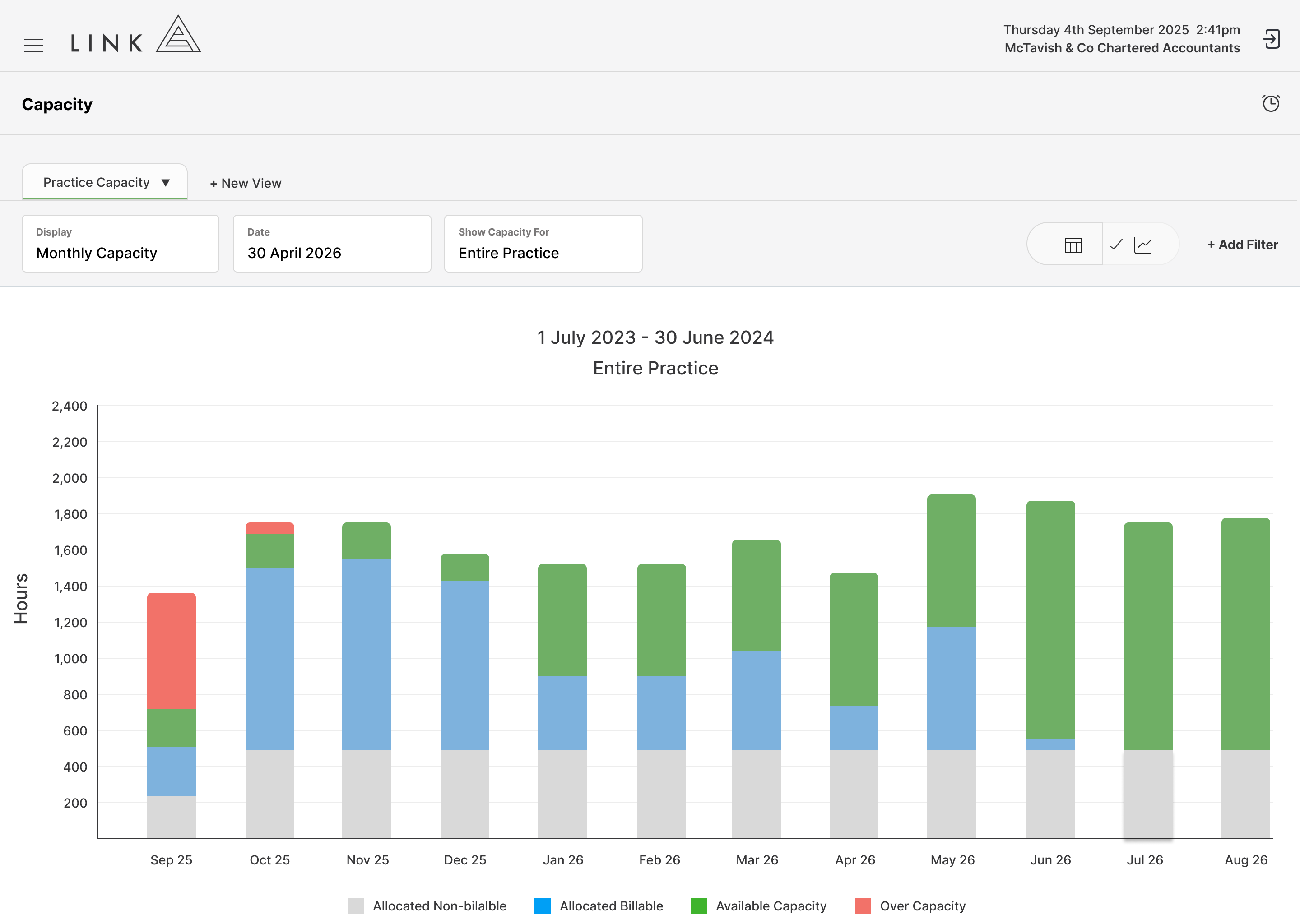
You need to know the progress and status of that work as it's completed. Jobs that take longer than expected affect the amount of money a team member can make you in a month (their availability). This hurts you twice: first in the value of previously allocated revenue the team member can no longer deliver this month, and second in the inevitable write-off that follows a job budget being exceeded. This is how a connected workflow feeds capacity, and capacity is revenue for fixed fee firms.
Connected Practice Management
The status of jobs also affects invoicing. In a fixed-fee world, the timing and basis of invoicing is determined in the proposal.
Nobody should have to ask 'how are we invoicing this?'
Nobody should have to ask 'is this finished?'
Traditional monthly invoicing cycles inherited from an hourly-rate era don't need to exist. Invoices are able to be drafted and created off the back of workflow completion.
But to get there, you need proposals that allocate the scope of work with reference to your team's availability. This is why having proposals that feed allocation with reference to capacity is so important. The value of the work, the basis of invoicing, who it's allocated to and for when: all of this needs to be known at the time you allocate work and every moment thereafter. So that everyone knows the volume of work and value of revenue you can expect is achievable.
The Missing Piece: Reimagining the WIP Ledger
The missing piece that makes all of this possible is a Reimagined WIP Ledger.
One of the underappreciated benefits of hourly billing was that underlying every invoice was a team member. Every invoice had a timesheet associated with it on the date of invoice. Write-ons and offs were visible, attributable, and timely. Fixed fees appeared to take that away, but they don't have to.
The WIP Ledger is where invoiced values get attributed back to the people and activities that generated them: timesheets, disbursements, individual deliverables. In a fixed-fee world with Connected Practice Management, at the time an item from a client's scope of services is completed in a team member's workflow, the value of the invoice is known, and the value of the time is known. Write-ons/offs can be attributed to people and services on the date of workflow completion! Not just on a future WIP wash-up date, or having to wait for the entire scope of work to be completed.
This returns firm owners to the transparency and visibility they had before fixed fees, with better margins and happier clients.
What it returns to your firm
Invoiced values are attributed to individual timesheet and disbursement entries using the proposal and workflow information in order to inform people, client, job, service and practice performance reporting. By measuring invoiced value by team member in an accurate and timely way down to the individual timesheet level, there is nowhere to hide. Pay reviews become much easier. Firm owners are better able to reward and retain their highest performing team members. They are also able to reduce the overwhelm those team members experience by ensuring the work they are allocated is in reference to their availability, not just at the time of allocation but every moment thereafter via their day-to-day interactions with their workflow.
Pricing is the pinnacle of this. It encompasses expectations from the previous proposal, the allocation of work, the actual delivery time, value and status, through to the invoice apportionment in the Reimagined WIP Ledger, arriving back to inform the next proposal. A firm owner no longer needs to wait for the scope of work to be completed to re-price the next engagement. Accurate re-pricing information is available throughout the Connected Practice Management loop, so a firm owner can always be ready to make an informed re-pricing decision whenever they might next be meeting the client.
The Firm that gets smarter
The Connected Practice Management loop then re-starts. Re-pricing re-informs who the work is allocated to and when, the new budgets, each team member's capacity, and workflow for the year ahead. Each rotation improves the pricing and delivery of your clients' services and aligns incentives between the client and the people in the firm. With each rotation, the gap between what you charge, what it costs to deliver, and what your team is capable of narrows. The firm gets smarter, it adapts to changing client needs quicker and so does the pricing.
Fixed fees are better
Hourly billing was simple. Fixed fees are better. But better only works if you can see what's happening. That's why we built Link.